


If you want to get a leaflet file, please download file below:
How do I apply for refugee status?
Can LGBTI+ people (sexual minorities) apply for refugee status?
“Refugees” mean people who fear persecution due to their race, religion, nationality, political opinion or membership of a particular social group (LGBTI+ people, women, persons with disability), and owing to such fear can’t or don’t want to receive protection from their home country (country of nationality or country they used to live in).
What you say during the application is confidential and kept secret. If you fear persecution based on your sexual orientation (being gay, lesbian, bisexual, etc.) or gender identity (being transgender, non-binary, etc.) and can’t go back to your home country because of that fear, you can apply for refugee status. If this is the case, you can mention your identity as an LGBTI+ person and the persecution you fear in your refugee application.
Where do I apply?
During the immigration inspection at the port of entry (for example, airport). OR If you are already staying/living in the RoK, at your local immigration office, branch office or at the immigration detention center.
What happens after the application?*
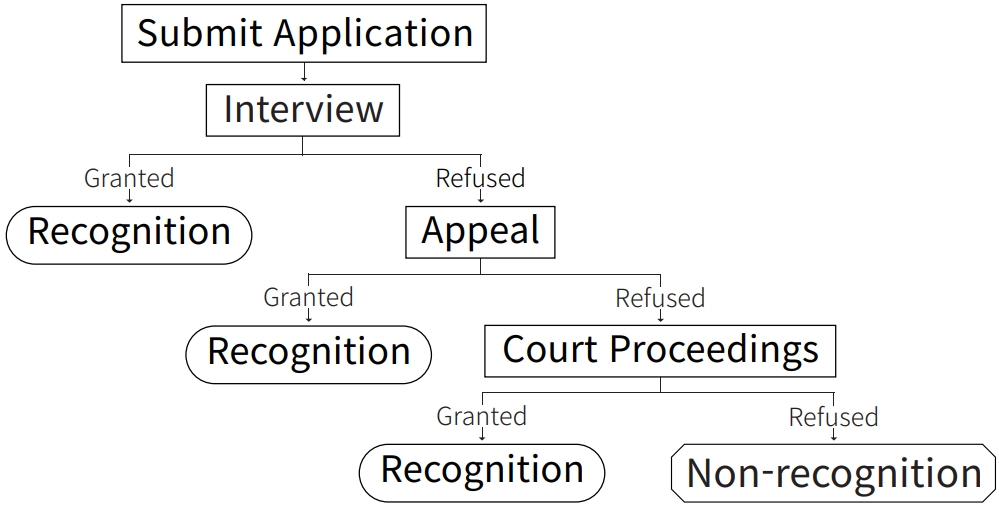
*for the details on the refugee procedure, please refer to the Korean MoJ Handbook in the helpful resources link.
Do I need to submit evidence?
The most important part in your refugee application is your testimony. It is crucial to write your experience as detailed as possible in your written Application for Refugee Status Recognition (난민인정신청서). If you’ve experienced persecution in the past, you can submit any supporting (and relevant) material. It is advisable to gather as much as evidence you think will help with your application. However, if you are asked to submit evidence that is sexually explicit or too private, you do not have to submit such evidence.
How do I fill out an Application for Refugee Status Determination?
Because refugee procedures will proceed based on the contents of your written application, it must be filled out as carefully as possible. It is advisable to think about the timeline, people’s names, places, etc. when you fill out the application.
In the application, write down your personal information and the details of the persecution you fear or experienced. “Persecution” usually includes threats to life, physical or psychological violence, serious human rights violations, repeated discrimination and/or other cruel and unfair treatments.
Not all LGBTI+ people go through the same experience. It is important to write down your own experience as an LGBTI+ person and fear of persecution.
If you are not sure what to write in your application, think about your own experience based on the following questions.
Persecution
If you were to be open about being an LGBTI+ person, would you be able to live safely in your home country?
•
What happens to those who are open about being LGBTI+ people in your home country?
•
How did others react when they learned that you are an LGBTI+ person? How did this reaction affect you?
What do you think would happen if you went back to your home country?
Have you ever been persecuted in your home country for being an LGBTI+ person?
What kind of persecution was it? (physical/psychological violence, harassment, blackmailing, etc.) Think of it based on 5Ws and H (who, what, where, when, why, how).
•
[Persecution by Government] Have you ever been persecuted by a state authority or institution for being an LGBTI+ person?
◦
Which authority or institution persecuted you? (police, army, government officials, etc.)
•
[Persecution by Private persons] Have you ever been persecuted by your family, relatives, neighbors, etc. for being an LGBTI+ person? Have you ever reported or asked for help to a state authority or institution (for example, to police)?
◦
How did the authority or institution respond?
◦
If you didn’t ask for help, what was the reason?
◦
If the authority or institution refused to help you, what do you think the reason was?
Think about your experience of realizing your identity as an LGBTI+ person based on the following questions if they apply to you.
Understanding sexual orientation and gender identity
How did you realize you were different from other people? Was there any specific reason, event or experience that made you realize that? How do you currently define or identify yourself?
Have you ever told someone else that you are an LGBTI+ person? If yes, how did they react to it?
[Sexual orientation] Have you ever dated or been in a relationship with a person of the same sex? What was that experience like? Were there any consequences from it? (You don’t need to include details about your sexual relations)
[Gender identity] If you wanted to change the sex in your official documents or change your body according to your gender identity, have you ever tried to do so? If not, or if you couldn’t, what was the reason? Do you intend to try in the future?
Others
Do you know anyone with a similar identity and/or orientation as you or other LGBTI+ people back in your home country? What are their lives like in your home country?
Did you have a chance to interact with someone with a similar identity and/or orientation as you or other LGBTI+ people in your home country? If yes, what was that experience like? If you couldn’t or it was difficult to interact with them, what was the reason?
Have you ever lived somewhere in your home country other than the place where you were persecuted? What was the experience like?
How does the refugee interview proceed?
Please note that based on the information you submitted in your refugee application, the eligibility officer will ask you some questions during the interview to better understand the reasons you presented in your application.
Rights of refugee applicants
A fair and respectful interview process is well within the rights of refugee applicants.
Confidentiality
The interview process follows the principle of confidentiality, and what you say during the interview
is not shared elsewhere. You can freely speak of your experiences.
Privacy
During the interview, if you are asked any sexually explicit questions or asked to submit overly personal evidence, please note that those questions/evidence are not necessary to determine your case; you can refuse to respond.
Bringing trusted individuals
If you request, a trusted individual (lawyers, activists, etc.) can accompany you to the interview as long as it doesn’t affect the fairness of the process.
Interpretation
Neutral and accurate interpretation is crucial in the interviews. If you feel like the interview is not interpreted properly, you can ask for another interpreter. When you receive the notice of the interview schedule, you can request in advance that interpreters of speaking certain languages, of certain religions or from certain regions to be excluded.
Audio and video recording
Every interview must be audio and video recorded. Before and during the interview, you may ask to
check if the interview is being recorded properly. You can request access to the audio and video recording after the interview. This is one of the rights refugee applicants are entitled to.
Written record
At the end of the interview, the officer will read you the written record of the interview. It is important to stay focused and confirm whether this record is accurate even if the long interview exhausted you. If the record included something you didn’t say, or left out what you actually said, you can request it to be edited. You can also request access to the written record and get a copy of it after the interview.
Duty of refugee applicants
Refugee applicants also have the duty to provide all relevant information as truthfully and in a detailed and specific manner as possible and cooperate with the interview process.
Helpful Resources
Available Help
UNHCR Representation in the Republic of Korea
•
Email counseling: info.korea@unhcr.org
•
Homepage: www.unhcr.or.kr
•
Refugee Rights Center (NANCEN)
•
Email counseling: refucenter@gmail.com
•
Phone counseling: 02-712-0620 (Wed 10AM ~ 5PM)
•
Homepage: https://nancen.org/
Ministry of Justice Immigration Contact Center (1345)
•
Phone counseling: 1345 (Weekdays 9AM ~ 10PM)
•
Interpretation in various languages available
(only Korean, English and Chinese available after 6PM)
bbb Korean (free interpretation service)
•
Phone: 1588-5644
•
Produced by Rainbow Refugee Network
GongGam Human Rights Law Foundation, HIV/AIDS Human Right Solidarity Nanuri+, Refugee Rights Center (NANCEN), Solidarity for LGBT Human Rights of Korea, Yongsan Nanum House_Anglican Church of Korea
Sponsor UNHCR Korea & Heinrich Böll Stiftung